1

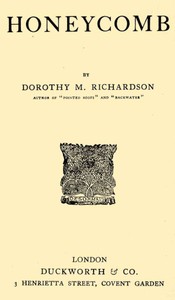
Honeycomb — Background and Themes
6
3
Project Gutenberg
2018
Autobiographical fiction; Women -- England -- Fiction; England -- Social life and customs -- 20th century -- Fiction
Readers of public-domain and historical texts
Project Gutenberg digital edition
en
Edition facts
Words: 57,631
Reading time: 251 min
Text sections: 6
Source:
Project Gutenberg record #56664
In the third volume of Pilgrimage, Miriam Henderson's sensory impressions and inner conflicts unfold through a spring arrival, a household's secret excitement, and her solitary painting sessions, revealing a consciousness shaped by place and social expectation.
Editorial Edition Score
4.7/5
★★★★★
★★★★★
Calculated from edition completeness, EPUB availability, text structure and catalogue metadata. Not a user rating.
Edition quality
From the opening paragraph, Honeycomb immerses the reader in Miriam Henderson's sensory world: stepping from a train into darkness, she registers the smell of wet bark, moss, and damp leaves before any human encounter. The narrative voice stays close to her perceptions, noting that the phrase "How lovely the air is here" repeats itself as her only resource to meet the new situation. This reliance on immediate sensation over social script sets the pattern for the excerpts that follow.
The catalog subjects label the book as autobiographical fiction about women in early twentieth-century England. Yet the excerpts show a protagonist less concerned with customs than with her own fluctuating attention—to spring's tawny and purple gleamings, to a candlelit room described as "like a shrine," and to the challenge of capturing Brighton skies in watercolor. The social world intrudes obliquely, through fragments of conversation about a "horrible mystery" in London and a visitor's pointed advice on Miriam's smile and evening dresses.
Arrival and the Weight of Sensation
The journey from London to a country house is rendered not as a sequence of events but as a series of sensory and emotional states. Miriam recalls the past winter in Gunnersbury through isolated moments: shivering over small fires, a quarrel with her mother, a confrontation with her father. These memories surface not in chronological order but as flashes triggered by the present. The narrative dwells on the quality of spring light—"tawny and purple gleamings through soft mist"—rather than on plot developments. This technique aligns with the catalog subject of autobiographical fiction, but the excerpts emphasize how Miriam's consciousness filters experience through physical detail, making the external world a mirror for inner life.
Household Secrets and Unspoken Tensions
At the Corrie household, Miriam observes but is not fully part of the "little groups of conspirators" who talk in corners about a man referred to only as a "genius" and a "woodland springtime name." The narrative withholds explicit explanation, leaving the reader to piece together that a scandal or disgrace in London is being discussed. Miriam's reaction is telling: her sympathies "veered vaguely out towards the patch of disgrace" and then her interest died down. The arrival of Miss Tower—a woman with a slight limp who speaks to Miriam as if she has known her all her life—introduces another layer of social performance. Miss Tower's advice to smile more and to alter her evening dresses underscores the gap between Miriam's inner world and the expectations placed on her.
Solitary Painting and the Struggle for Expression
Fleeing to her room after the children's tea, Miriam takes up watercolor painting in an attempt to capture memories of Brighton skies. The excerpts describe her process in visceral terms: her heart and hand shake, her body thrills, and she breathes heavily as she works. Yet the results are "thick and confused," a "confused mass of shapeless images" that leave her angry. This episode crystallizes a central tension in the novel: Miriam's desire to register reality with precision clashes with her inability to translate perception into satisfactory form. The catalog subject of women in England is present, but the excerpts focus on an internal, artistic struggle rather than on social commentary or plot progression.
Readers approaching Honeycomb should attend to the rhythm of Miriam's consciousness rather than expecting a conventional narrative arc. The novel's power lies in its accumulation of sensory detail and the gaps between what Miriam perceives and what she can articulate. The excerpts offer no resolution to the hinted scandal or to Miriam's artistic frustrations; instead, they invite the reader to inhabit a mind in process, where meaning emerges from the texture of moments rather than from events.
Reader reflection
Take a moment to reflect on this book
Create a short personal record of your experience with this book.
Your progress
0
/
10
2
Did this book hold your interest?
3
How likely are you to recommend this book?
4
How much effort did this book require?
5
How strongly did the book affect you emotionally?
6
Could you follow the author’s main argument?
7
Was the book what you thought it would be?
8
Would this book work well in a reading group?
9
What changed or sharpened your thinking?
10