1

Limbo — Context and Discussion
9
4
Project Gutenberg
2017
Short stories, English; English fiction -- 20th century; English drama -- 20th century
Readers of public-domain and historical texts
Project Gutenberg digital edition
en
Edition facts
Words: 53,961
Reading time: 235 min
Text sections: 22
Source:
Project Gutenberg record #54895
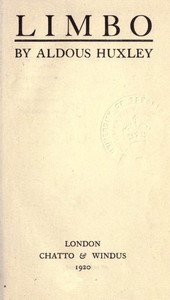
Aldous Huxley's 1920 collection of short stories and a play, marked by ironic detachment, precise social observation, and a fascination with the gap between aspiration and reality, as seen in characters like a boy hiding his dollhouse play and a schoolmaster extolling discipline.
Editorial Edition Score
4.8/5
★★★★★
★★★★★
Calculated from edition completeness, EPUB availability, text structure and catalogue metadata. Not a user rating.
Edition quality
In the opening story, a boy named Dick secretly plays with his sister's dollhouse while affecting indifference, whistling a tune as he strolls out when anyone enters. This small scene encapsulates a recurring tension in Huxley's Limbo: the contrast between private desire and public performance. Throughout the collection, characters are caught between what they feel and what they show, often with comic or poignant results.
The excerpts reveal a writer attentive to the nuances of voice and gesture. A schoolmaster's hearty jocularity, a dyspeptic guest's regret over duck, and a young man's earnest discussion of César Franck all emerge through dialogue that is both natural and pointed. Huxley's prose is precise, favoring concrete detail over abstraction, and his irony is understated rather than overt.
Diction and the Weight of Words
Huxley's word choice often carries a double edge. In the dollhouse scene, the description of the ham's 'internal complexion of the loveliest pink and white' is almost clinical, undercutting the expected childish wonder. The phrase 'replete with every modern convenience; sumptuous appointments' mimics advertising copy, suggesting a world where objects are marketed rather than cherished. Later, a schoolmaster's claim that 'the best thing the war has brought us is discipline' is delivered with 'zeal,' yet the context—a dinner table where younger voices discuss art—invites skepticism. Huxley does not editorialize; he lets the diction speak for itself, trusting readers to catch the dissonance.
Dialogue as Social Choreography
Conversations in these excerpts are rarely straightforward exchanges; they are performances of status and affiliation. At the dinner table, Roger's hearty offers of port and his remarks on cherries are bids for authority, while the younger characters, Guy and Marjorie, talk past him about French and Russian views of life. The 'sir' that slips out from White, a former pupil, marks the persistence of old hierarchies. Huxley captures the way people talk at each other, not always to each other. The American visitor Jacobsen's light comment—'So is all education, I dare say'—is a quiet challenge to Roger's certainties, but it is left hanging. The dialogue reveals character through rhythm and interruption, not just content.
Description and the Telling Detail
Huxley's descriptive passages are economical but vivid. The dollhouse is 'almost as grandiose and massive as' Aunt Loo herself, linking object to person in a single simile. A character's face 'wore an expression of dyspeptic melancholy' after too much duck—physical state mirrors emotional tone. The schoolmaster's face 'glowed with zeal' as he praises discipline, a detail that suggests fervor but also, in context, a kind of blindness. These descriptions do not merely decorate; they advance a subtle critique. The 'cold collation' of lobsters and ham, untouched, becomes a symbol of unused potential, much like the characters' own unfulfilled lives. Huxley trusts the image to carry meaning without explicit commentary.
Structure and the Unfinished Arc
The excerpts are fragments, but they hint at a structural pattern: scenes that begin with a concrete object or event and then widen into social comedy. The dollhouse story starts with a birthday gift and moves to the boy's secret play and his school report; the dinner scene opens with port and cherries and expands into debates on education and art. Huxley often ends a scene on a note of irresolution—a question unanswered, a conversation trailing off. This refusal to tie up loose ends mirrors the 'limbo' of the title: a state of suspension. Readers are left to infer the weight of what is not said, a technique that rewards attention to the spaces between lines.
These excerpts offer a sample of Huxley's early prose, already marked by the wit and social acuity that would define his later work. Readers attentive to the interplay of dialogue and description will find a writer who observes his characters with a cool, precise eye, neither condemning nor celebrating them. The collection's title, Limbo, suggests a middle state, and the stories inhabit that territory: between childhood and adulthood, earnestness and irony, aspiration and reality. Approach these tales as a series of finely drawn sketches, each a study in the distance between what people say and what they mean.
Reader reflection
Your personal reading reflection
Build a private reading journal entry for this title.
Your progress
0
/
10
2
Did this book hold your interest?
3
How likely are you to recommend this book?
4
Did the language feel accessible?
5
Which part made the strongest impression?
6
How useful did the reading feel?
7
Did this book create an emotional response?
8
Did any part of the book feel personally relevant?
9
In one sentence, what did you learn?
10