
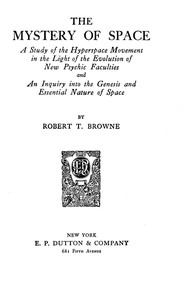
The mystery of space : a study of the hyperspace movement in the light of the…
Let's set the scene: it's 1919. Einstein's theories are turning physics upside down, spiritualism and séances are huge, and a guy named Robert T. Browne sits down to write a book. But he's not picking a side. Instead, he asks a radical question: what if both sides are talking about the same thing?
The Story
There isn't a traditional plot with characters. Instead, Browne builds an argument, piece by piece. He starts with the cutting-edge math and physics of his day, particularly the new ideas about a fourth dimension (what he often calls 'hyperspace'). He explains it as clearly as he can for a 1919 audience. Then, he takes a sharp turn. He suggests that phenomena reported by psychical researchers—telepathy, apparitions, clairvoyance—aren't supernatural at all. He proposes they are natural events leaking into our three-dimensional world from this higher-dimensional space. The 'story' is his journey to connect these two seemingly separate worlds into one coherent theory.
Why You Should Read It
You read this book for the sheer, audacious thought experiment. It's less about whether Browne was 'right' and more about watching a brilliant, curious mind try to build a bridge where no one else thought to look. His earnest attempt to bring rigor to the paranormal is captivating. You can feel his frustration with both closed-minded scientists and credulous spiritualists. He's searching for a middle path, and his tool is the most exciting science of his era. It's a snapshot of a time when the boundaries of reality felt incredibly fluid. Reading it today, with our modern discussions about dark matter, quantum weirdness, and simulated realities, makes his ideas feel oddly prophetic, or at least poignantly hopeful.
Final Verdict
This book is a treasure for a specific reader. It's perfect for anyone who loves the history of science and weird ideas. If you enjoy books like Charles Fort's The Book of the Damned, or you're fascinated by how people at the dawn of modern physics tried to make sense of a strange world, you'll find this gripping. It's not an easy beach read—some of the geometry talk is heavy—but it's a rewarding trip into the attic of 20th-century thought. You come away not with answers, but with a renewed sense of wonder about all the mysteries still on the edge of our understanding.
This content is free to share and distribute. You can copy, modify, and distribute it freely.
Emily Anderson
1 year agoI was skeptical about the depth of this book at first, but the way it handles controversial points with balance is quite professional. I'll be recommending this to my students and colleagues alike.
Lisa Flores
1 year agoPerfect.
Emily Hernandez
7 months agoGood quality content.
Sarah Robinson
1 year agoFast paced, good book.








Jennifer Perez
6 months agoThe analytical framework presented is both innovative and robust.