
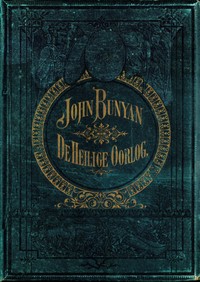
De Heilige Oorlog, gevoerd door Koning Elschaddai tegen Diábolus by John Bunyan
John Bunyan, the man who gave us the classic The Pilgrim's Progress, wasn't done mapping the spiritual life. In De Heilige Oorlog (The Holy War), he swaps the pilgrim's path for a battlefield. This is the story of a city called Mansoul, a beautiful creation of the good King Elschaddai. But the city is tricked and violently taken over by Diábolus and his nasty crew—captains with names like Lust, Fury, and Hate. They corrupt everything, placing doubt and despair in charge of the city's towers.
The Story
The plot is a siege. King Elschaddai sends his son, Prince Emmanuel, with a mighty army to win Mansoul back. The battle isn't fought with ordinary swords, but for control of the city's five gates: Ear-gate, Eye-gate, Mouth-gate, Nose-gate, and Feel-gate. Bunyan turns a spiritual idea into a gripping military campaign. Will the truth break through Ear-gate? Can the citizens recognize their true king? The back-and-forth struggle for the city is surprisingly tense. Just when you think the king has won, a traitor inside opens a side gate, and Diábolus sneaks back in. It's a war with many battles, showing that the fight for a person's soul is long and messy.
Why You Should Read It
What grabs me is how personal this epic feels. Mansoul isn't just any city; it's a picture of a human being. When I read about Diábolus corrupting the Lord Mayor (Understanding) and the Recorder (Conscience), I immediately thought about times my own judgment has been clouded. Bunyan isn't just telling a story; he's holding up a mirror. The characters aren't flat symbols—they feel real. You wince when Mansoul makes a bad treaty, and you cheer when a simple character like Mr. Pry-Well exposes a traitor. It makes ancient ideas about sin and grace feel urgent and immediate.
Final Verdict
This book is perfect for anyone who loves a great allegory but wants more strategy and conflict than a simple journey. If you enjoyed the world-building in C.S. Lewis's The Screwtape Letters or the internal battles in a Dostoevsky novel, you'll find a fascinating ancestor here. It's also for readers who don't mind a challenging, older style—the language is from the 1600s, so it takes a few pages to find the rhythm. Don't rush it. Savor the imagery. De Heilige Oorlog is a demanding, dramatic, and deeply insightful map of the human heart, disguised as a legendary war story.
This title is part of the public domain archive. It is now common property for all to enjoy.
John Robinson
2 years agoGreat digital experience compared to other versions.
Susan Lewis
1 year agoClear and concise.
Mary Hernandez
6 months agoI started reading out of curiosity and it manages to explain difficult concepts in plain English. Absolutely essential reading.