
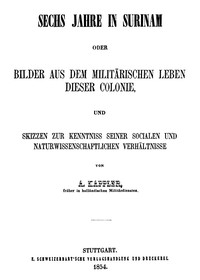
Sechs Jahre in Surinam by A. Kappler
August Kappler's book is his personal record of six years spent in the Dutch colony of Suriname (modern-day Surinam) from 1836 to 1842. He arrived as a young soldier but quickly became captivated by the place, eventually serving as a curator for natural history collections.
The Story
This isn't a novel with a traditional plot. Instead, it's a chronological journey through Kappler's experiences. He details the grueling daily life of a colonial soldier, the strange hierarchy of plantation society, and his expeditions into the interior. We follow him as he collects insects, describes plants no European had ever cataloged, and navigates relationships with Dutch colonists, enslaved Africans, and Indigenous communities. The "story" is his gradual transformation from an outsider following orders to a keen-eyed resident documenting a complex, often brutal, ecosystem—both natural and human.
Why You Should Read It
What makes this book special is Kappler's dual perspective. He was part of the colonial system, yet his true passion was the natural world, which he describes with genuine wonder. You get the sense of a man constantly torn: between duty and curiosity, between European prejudices and the evidence before his eyes. His descriptions of the rainforest—the sounds, the oppressive heat, the incredible biodiversity—are vivid and immersive. He doesn't romanticize the colony; he shows its hardships and injustices, but filters it all through the practical lens of a man trying to understand his surroundings. It feels honest and unvarnished.
Final Verdict
Perfect for history buffs who want a ground-level view of 19th-century colonialism, or for nature lovers curious about early scientific exploration. If you enjoy travelogues or primary source diaries that drop you directly into another time and place, this is a fascinating read. It's not a fast-paced adventure, but a slow, absorbing immersion. Be prepared for the language and attitudes of the 1800s, but read it as a captivating snapshot from a witness who was there, machete in one hand and notebook in the other.
This digital edition is based on a public domain text. It is available for public use and education.
Linda Gonzalez
5 months agoThe analytical framework presented is both innovative and robust.
Ashley Johnson
4 months agoThis is an essential addition to any academic digital library.
Barbara Williams
9 months agoI was skeptical about the depth of this book at first, but the author clearly has a deep mastery of the subject matter. If you want to master this topic, start right here.
Patricia Martin
6 months agoI appreciate how this edition approaches the core problem, it addresses the common misconceptions in a very professional manner. It definitely lives up to the reputation of the publisher.





Jessica Harris
10 months agoLooking at the bibliography alone, the inclusion of diverse viewpoints strengthens the overall narrative. An excellent example of how quality digital books should be formatted.