
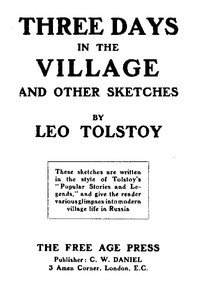
Three Days in the Village, and Other Sketches. by graf Leo Tolstoy
This isn't your typical Tolstoy. Put aside the epic scale of his famous novels. 'Three Days in the Village, and Other Sketches' is exactly what it sounds like: a series of short, observational pieces written late in Tolstoy's life. He had turned his back on high society and was living on his family estate, Yasnaya Polyana, deeply involved in the daily life of the village.
The Story
There's no single, driving plot. Instead, each sketch is a window. In the title piece, Tolstoy narrates three days of his own life—dealing with a horse thief, mediating disputes, and observing the harsh realities of peasant existence. Other sketches might follow a poor man seeking help, detail the backbreaking work of the harvest, or capture a fleeting moment of interaction. The 'story' is the accumulated weight of these moments. You see the vast gap between the landowner's comfort and the peasant's struggle, the often absurd bureaucracy, and the small acts of kindness that persist anyway. It feels less like fiction and more like passionate, annotated reality.
Why You Should Read It
I love this book because it shows Tolstoy without the filter. This is the man, not just the legendary author. His moral fury at social inequality is palpable, but so is his deep affection for the land and its people. You get his dry wit when describing a pompous official, and his genuine anguish when faced with a family's poverty. It strips away the historical distance and makes his concerns feel urgent and human. Reading these sketches is like walking alongside him, listening to him point out everything the world chooses to ignore.
Final Verdict
This book is perfect for curious readers who want to understand the real Tolstoy, not just the literary monument. It's great for anyone interested in social history, or for those who enjoy thoughtful, descriptive nonfiction. If you've been intimidated by 'Anna Karenina,' consider this a fascinating and accessible primer. It’s also a brilliant pick for short story fans—each sketch is a complete, powerful little world. Just don't go in expecting a sweeping romance; come ready for a clear-eyed, sometimes challenging, and deeply personal walk through a Russian village.
This historical work is free of copyright protections. You are welcome to share this with anyone.
Anthony Harris
9 months agoGreat read!
Elijah Harris
1 year agoHelped me clear up some confusion on the topic.
Oliver Flores
2 years agoGood quality content.
Deborah Clark
8 months agoClear and concise.
Andrew Hernandez
1 year agoA bit long but worth it.